The Air Ambulance Alternative
Long Distance Medical Transport Your Family Can Make Together
If a doctor, nurse, or case manager told you your loved one needs to be moved hundreds of miles for care, you were probably pointed toward a medical flight. There's a second option most families never hear about — and for many trips, it's the better one.
"You'll Need to Arrange a Medical Flight"
It usually happens fast. A parent is in a hospital far from home, or needs to move closer to family for ongoing care, and the discharge planner says the words medical flight or air ambulance. Most hospital staff genuinely don't know there's another way to move a patient 500, 1,000, or even 2,500 miles with medical care the entire time.
That's not a criticism of hospitals — air ambulance companies have spent decades making sure they're the first call. But it means most families price out a flight, absorb the sticker shock, and never learn that long distance ground medical transport exists: a fully equipped medical vehicle, a licensed medical professional at the bedside the whole way, and room for the family to come along.
This page lays out both options honestly. We coordinate both — our parent company, Air Critical Care, operates air medical transport worldwide — so we have no reason to push you toward one or the other. Our only goal is the right fit for your loved one.

What Booking an Air Ambulance Actually Involves
Air medical transport is a remarkable service — and for some patients it's the only right answer. But before you book, it helps to know the parts nobody mentions up front.
The Real Cost
Most domestic air ambulance flights are quoted between $20,000 and $150,000+, depending on distance and the level of care on board. Insurance rarely covers non-emergency transfers in full. Long distance ground transport over the same route is typically a fraction of that cost.
The Hidden Ground Legs
A "flight" is really three trips: a ground ambulance to the airport, the flight itself, and another ground ambulance at the destination. That means three vehicles, multiple patient hand-offs between crews, and coordination across three companies — each transfer a chance for stress, delay, and miscommunication.
Family Usually Can't Come
Medical aircraft have strict weight and space limits. Many flights allow one passenger at most — some allow none. For a frightened or confused patient, arriving alone in an unfamiliar city is often the hardest part of the journey.
Weather & Altitude
Flights get delayed or scrubbed by weather, and cabin pressure changes can be a concern for patients with certain cardiac, pulmonary, or post-surgical conditions. A ground vehicle leaves on schedule in almost any weather and stays at ground level the entire trip.
Ready to Speak with an Expert Transport Coordinator?
Our team is standing by ready to help.
Professional medical transport with Mercedes Sprinter vehicles. 200+ miles minimum. Medical professional on every trip.
The Option Most Families Are Never Told About
Long distance ground medical transport: one vehicle, one medical team, bedside to bedside — with your family on board.
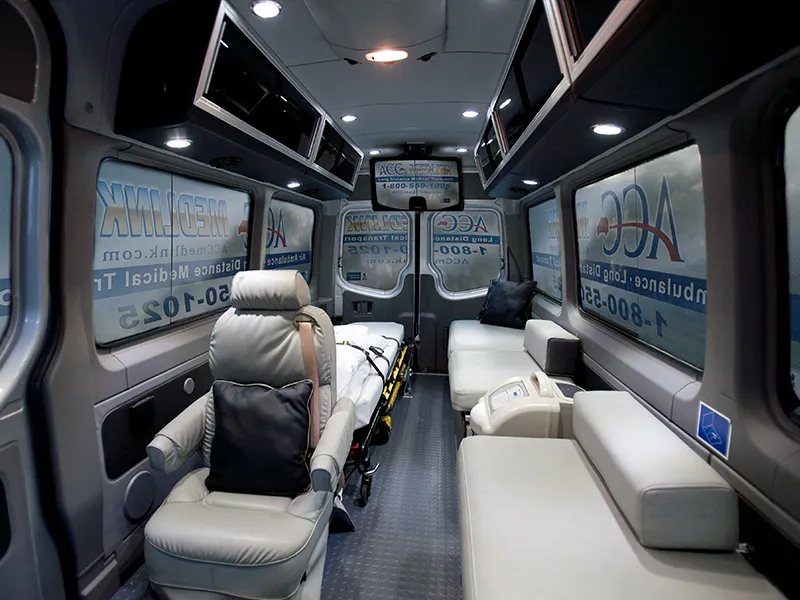
One Vehicle, Zero Hand-Offs
We pick your loved one up at their bedside and deliver them to the bed at the destination. The same medical team stays with them the entire trip.
Licensed Medical Professional On Board
An RN, LPN, or EMT-Paramedic rides at the patient's side — monitoring vitals, managing medications and oxygen, and never leaving them alone.
Up to 2 Family Members Ride Free
Our Mercedes Sprinters carry the patient plus two loved ones at no extra charge. Nobody arrives alone, and family sees the care being given firsthand.
Built for Long Trips
8-inch memory foam medical mattress, climate control, entertainment, and full medical equipment in a DOT-approved vehicle — with two certified drivers rotating so the trip runs straight through.
A Fraction of the Cost of Flying
No aircraft, no airport ambulances, no flight crew — the savings are substantial on almost every route, and we quote the exact price up front.
Air Ambulance vs. Ground Transport Side by Side
The honest comparison we walk every family through on the phone.
| Factor | Air Ambulance | Ground Transport |
|---|---|---|
| Typical Cost |
$20,000 – $150,000+ Varies by distance & care level |
A fraction of air Exact quote up front |
| Vehicles & Hand-Offs |
3 vehicles, 3 crews Ambulance → aircraft → ambulance |
1 vehicle, 1 team True bedside to bedside |
| Family On Board |
0–1, if space allows Strict weight limits |
Up to 2, free Comfortable seating & beds |
| Door-to-Door Time |
Fastest for 2,000+ mi But airport legs add hours |
Drives straight through Two rotating DOT drivers, no overnight stops |
| Weather Risk |
Delays & cancellations Especially small aircraft |
Minimal Departs as scheduled |
| Altitude Concerns |
Cabin pressure changes An issue for some conditions |
None Ground level the whole way |
| Medical Care En Route |
Flight medical crew Critical-care capable |
RN / LPN / EMT-Paramedic At the bedside, full trip |
Sometimes Air Really Is the Right Call — And We'll Tell You
Ground transport isn't the answer for every patient. Because our parent company, Air Critical Care, operates air ambulance and medical escort services worldwide, we can arrange either one — so our recommendation is based on your loved one's needs, not on what we happen to sell.
Air Makes Sense When:
- Time is genuinely critical — a transplant window, a deteriorating condition that needs a specialist within hours
- The trip is international or overseas
- The patient requires ICU-level critical care that must reach a destination across the country as fast as possible
Ground Usually Wins When:
- The move is planned rather than emergent — a discharge, a transfer closer to family, a new care facility
- Family wants to stay together — or the patient has dementia, anxiety, or simply shouldn't travel alone
- Cost matters — the budget for one flight can cover the transport with tens of thousands left for ongoing care
- Flying is medically risky — certain cardiac, pulmonary, and post-surgical patients shouldn't be at altitude
"But My Loved One Needs Real Medical Care En Route"
That's the most common worry — and the most understandable one. Here's the level of care that rides in every vehicle.
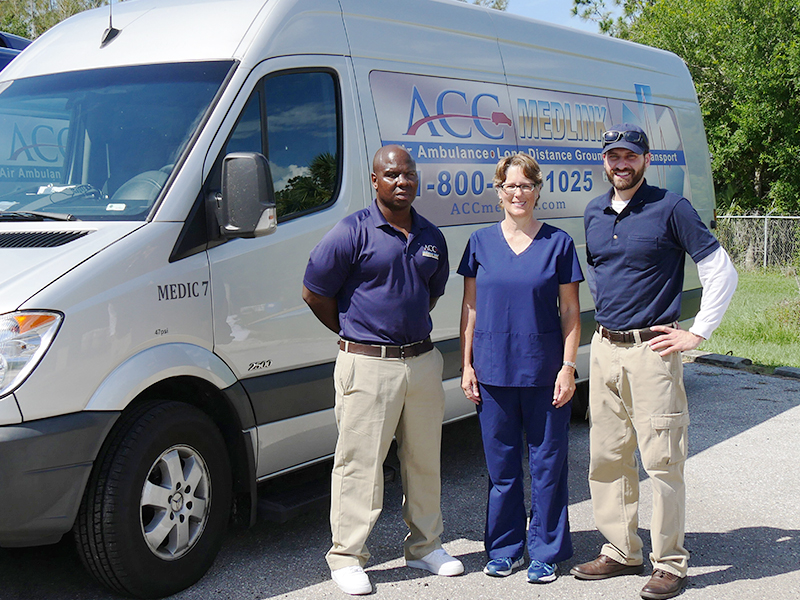
Clinical Care, the Entire Trip
- RN, LPN, or EMT-Paramedic on every transport
- Oxygen, monitoring, and full medical equipment on board
- Medication management on schedule throughout the trip
- 24/7 medical oversight with hospital rerouting if ever needed
- Complete medical hand-off report at the receiving facility
Patients We Transport Every Week
- Post-surgical and rehabilitation patients
- Oxygen-dependent, COPD, and cardiac patients
- Dementia and Alzheimer's patients who need familiar faces nearby
- Hospice patients traveling home with dignity
- Bariatric patients up to 700 lbs with specialized equipment
Compare ACC Medlink to the Competition
Here's how ACC Medlink upstages competing transportation services.
 Sprinter
|
Competitor Minivan Services |
Competitor RV Services |
|---|---|---|
|
Two professional drivers & medical professional Nurses can stand & properly care for patient en route |
Two drivers only Tight space, no headroom No room for proper care |
Medic and two drivers No way to load stretcher onto RV No room for proper care |
|
2-Time Safety Award winner at Fleet World Honours Nationwide fleet – expertly maintained Insured beyond all Federal requirements |
Questionable safety record Questionable maintenance record |
Structure not safe for passengers Questionable maintenance record No crash-safety standards required |
|
8-inch memory foam mattresses Passenger beds DOT-approved for safety ALL DOT safety requirements met |
2-inch plastic mattress DOT approval not verified |
Hospital-type bed DOT approval not verified |
|
Custom Bedside commode providing unparalleled access |
Bedpan only |
Small ambulatory bathroom Not ideal for patient transfer |
|
Low Emission Vehicles BlueTEC SCR technology Complies with strict EPA/CARB standards |
Not Low Emission Vehicles | Not Low Emission Vehicles |
From First Call to Safe Arrival in 4 Steps
Tell Us About the Trip
Call 24/7 or request a quote online. We'll listen, ask about your loved one's condition, and give you an honest read on ground vs. air.
Get an Exact Quote
One all-inclusive price for the whole trip — medical team, vehicle, fuel, family riders. No surprise billing afterward.
We Handle the Details
Medical record review, facility coordination at both ends, equipment prep, and scheduling — usually within 24–48 hours.
Bedside to Bedside
Your loved one travels with a medical professional at their side and family on board, with GPS updates for everyone waiting at home.
Questions Families Ask Before Deciding
How much does an air ambulance cost compared to ground transport?
Most domestic air ambulance flights run between $20,000 and $150,000+ depending on distance and the level of care required, and non-emergency transfers are rarely covered in full by insurance. Long distance ground medical transport over the same route is typically a fraction of that cost, and we quote one exact, all-inclusive price before you commit.
The hospital recommended a medical flight. Can we still choose ground transport?
In most non-emergency cases, yes. Hospital staff often default to recommending air because it's the option they know, not because ground was ruled out medically. Our medical team reviews your loved one's records and consults with the discharging physician. If the patient is stable enough for a planned transfer, ground transport is usually appropriate — and if it isn't, we'll tell you directly and help arrange the flight instead.
Is long distance ground transport medically safe?
Every transport includes a licensed medical professional — an RN, LPN, or EMT-Paramedic — at the patient's side with oxygen, monitoring, and full medical equipment. Two DOT-certified drivers rotate so the vehicle keeps moving safely. If a patient's condition ever changes en route, our 24/7 medical oversight team can reroute to the nearest appropriate hospital immediately — something no aircraft can do mid-flight.
How long does a 1,000-mile trip take by ground?
Our vehicles drive straight through with two rotating drivers — no overnight stops. A 1,000-mile trip typically takes around 16–18 hours door to door. Remember that a "2-hour flight" also includes ground ambulances and waiting at both airports, so the real difference is smaller than it sounds — and your loved one stays in one bed the entire time instead of being moved between vehicles four times.
Can family members really ride along?
Yes — up to 2 family members travel at no additional cost, with comfortable seating and sleeping accommodations. Most air ambulances allow one passenger at most, and many allow none. Families consistently tell us that staying together was the single biggest reason they chose ground.
Does insurance cover medical transport?
We are a private pay service with payment due at booking — we accept credit cards, checks, Zelle, and wire transfers. We provide detailed invoices and medical necessity documentation, and many families receive partial or full reimbursement from their insurance afterward. Either way, you'll know the exact cost up front, which is rarely true with air ambulance billing.
What if my loved one needs oxygen or special equipment?
Oxygen, monitors, Stryker power stretchers, and specialized equipment are standard on our DOT-approved Mercedes Sprinters — including bariatric equipment for patients up to 700 lbs. Tell us what your loved one needs and it will be on board and checked before pickup.
How quickly can a transport be arranged?
We typically schedule within 24–48 hours, and our 24/7 team can often accommodate same-day or next-day departures in urgent situations. Call 800-550-1025 any time, or use our online quote form — most quotes are provided within minutes on the call.
Families Who Made This Same Decision
Many of our reviews come from families who started out pricing medical flights.
Before You Book That Flight, Make One Phone Call
Five minutes with a transport coordinator will tell you whether ground or air is right for your loved one — with real numbers for both. No pressure, no obligation, and honest advice either way.