Ground vs Air Medical Transport: Which Is Right for You?
Both move a patient who can't travel on their own. The honest answer comes down to one question: how stable are they?
- ✓ Straight answer, both sides
- ✓ Coordinators answer 24/7
- ✓ Same-day quote, one price for everything
Answered 24/7 by our team, not a call center.

Sometimes the right answer is the airplane
If your loved one is critically ill or unstable (likely to decline within hours) an air ambulance is the right call, and we'll tell you so. A dedicated medical aircraft is the fastest way to move a patient who genuinely cannot afford a day on the road, and it reaches destinations no ground vehicle can.
But most families who call us aren't in that situation. Their loved one is stable: too fragile to sit up for a two-day drive, not cleared to fly commercial, but in no danger of declining overnight. For that patient, speed stops being the deciding factor, and everything else starts to matter: room, family, comfort, transfers, and what the trip costs.
That's the comparison below. If you want the deeper version, read our air ambulance alternative page and the complete family guide.

Ground vs air, factor by factor
The air column below describes a dedicated air ambulance: the honest version of each service, not a strawman.
| Factor | Ground TransportACC Medlink Sprinter | Air Ambulancededicated medical aircraft |
|---|---|---|
| Travel time | Longer on the roadTwo rotating drivers keep the vehicle moving; the patient sleeps in a real bed en route | Fastest for long distancesFlight time is short, but add ground ambulances and waiting at both ends |
| What the trip costs | A fraction of the air billPrivate-pay with a same-day quote; CareCredit and veteran discounts | Several times moreAircraft, flight crew, and two ground ambulance legs each add to the bill |
| Family aboard | Family rides alongA real seat and a bed beside the patient, the entire trip | LimitedSpace and weight restrictions often mean family flies separately |
| Transfers en route | No airportsBed to bed by road. Hospital room to bedroom | MultipleGround ambulance to tarmac, aircraft, tarmac to ground ambulance again |
| Patient comfort | Real bed, memory-foam mattressRoom for the attendant to stand and care for the patient | Clinical stretcher setupBuilt for treatment, not rest; cabin noise and pressure changes |
| Medical care aboard | Medical professional the whole tripOxygen aboard, medications on schedule | Critical-care capableThe right tool for unstable patients. This is where air genuinely wins |
| Weather | Rarely affectedRoutes adjust; departures stay reliable | Weather-dependentStorms and visibility can ground or delay flights |
| Where it goes | All 48 lower states, door to door200-mile minimum, no upper limit | WorldwideAirport to airport, with ground legs arranged at each end |
The pattern: air wins on raw speed and critical care; ground wins on almost everything a stable patient and their family actually experience: room, rest, company, no airports, and the size of the bill.
When air transport is the right choice
An air ambulance is a flying intensive-care unit. For some patients, nothing else will do:
- The patient is critically ill or unstable and every hour matters
- Care needs exceed what a ground vehicle can carry: continuous critical-care intervention en route
- The destination is overseas or otherwise beyond road reach
- The receiving hospital has set a hard arrival window a road trip can't meet
If that describes your situation, call us anyway. Our coordinators will say so plainly and point you in the right direction.
When ground wins
For a stable patient, the aircraft's one advantage (speed) buys very little and costs a lot:
- The patient is stable and simply can't sit up for a long drive or fly commercial
- You want family in a real seat beside the patient, with a bed to rest on, not on a separate flight
- Fewer handoffs matter: no airports or tarmac, hospital room to bedroom by road
- The bill matters: ground runs a fraction of an air ambulance
- Flying is off the table: anxiety, dementia, or a condition aggravated by cabin pressure
- You want a departure date that weather won't cancel
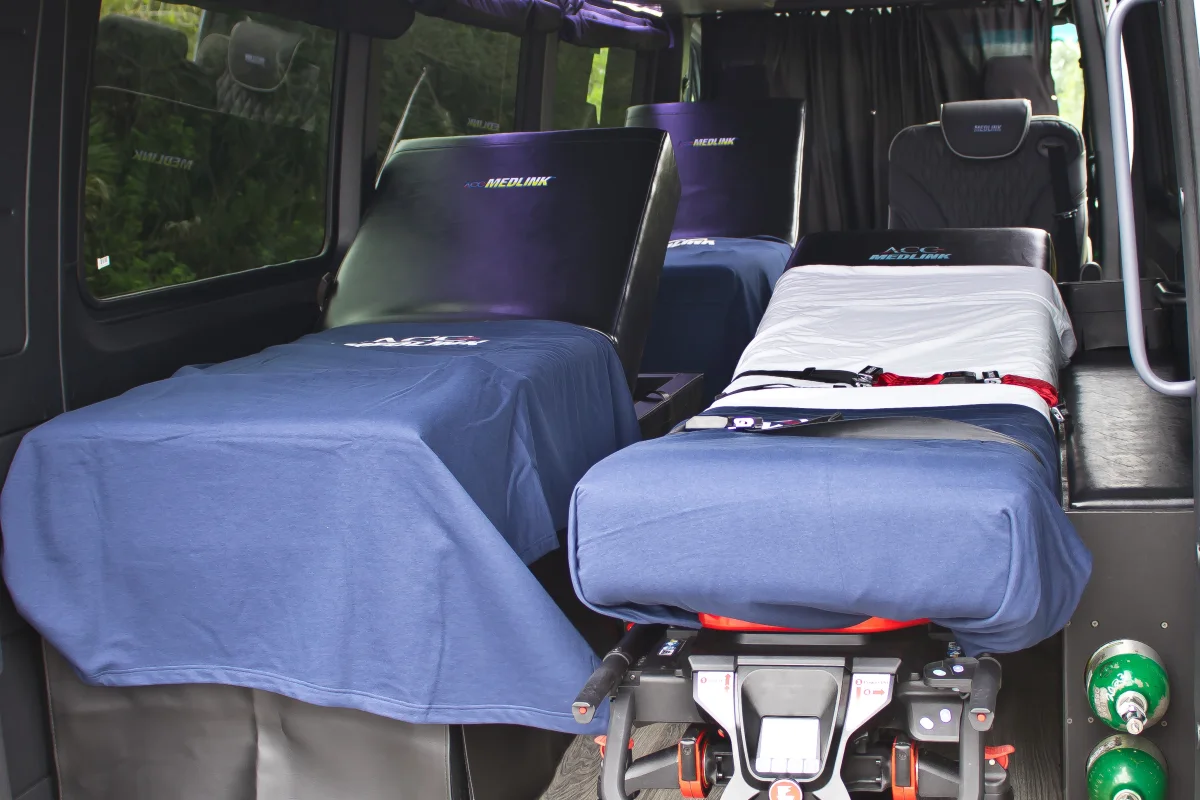
A hospital room that drives
Our Mercedes Sprinters are built around one idea: a stable patient should travel the way they rest, lying down, with family close. A real bed on a memory-foam mattress, oxygen aboard, medications kept on schedule by a medical professional who never leaves their side.
Two rotating drivers keep the vehicle moving safely through the night while they sleep. Fully licensed, with over ten million patient miles since 2010, door to door across all 48 lower states.
“My father was very ill and in Florida. We needed immediate medical transportation to get him back to his home state.”
Families who weighed the same choice
Every review below is from a verified post-trip survey.
from verified post-trip surveys
“On two occasions medical air transport was required. The services received were outstanding.”
“I could not be more pleased with this service and company. The people were fantastic and timely. They went above and beyond.”
“The pilots and the medical staff were top notch. They made a very stressful situation easier. I thank you so much for that.”
Compare ACC Medlink to the competition
How our Sprinters stack up against the vehicles other services send.
| ACC MedlinkMercedes Sprinter | Competitor Minivan Services |
Competitor RV Services |
|---|---|---|
| Two professional drivers & a medical professionalMedical attendants can stand and properly care for the patient en route | Two drivers onlyTight space, no headroom No room for proper care |
Medic and two driversNo way to load a stretcher onto an RV No room for proper care |
| Our own Mercedes Sprinter fleetNationwide fleet, expertly maintained Fully licensed |
Questionable safety recordQuestionable maintenance record | Structure not built for passengersQuestionable maintenance record No crash-safety standards required |
| Real beds with memory-foam mattressesA real bed, not a reclined seat | Thin plastic mattress | Hospital-type bed |
| Custom bedside commodeDignified access, no transfers | Bedpan only | Small ambulatory bathroomNot ideal for patient transfer |
| Low-emission vehiclesBlueTEC SCR technology Complies with strict EPA/CARB standards |
Not low-emission | Not low-emission |
How choosing (and booking) works
-
1
Call us once
Tell us their condition, the two addresses, and the timing. Our coordinator gives you a straight recommendation (ground, or air if that's truly the right tool) and a same-day quote.
-
2
We plan everything
Our coordinator works directly with the hospital's discharge planner: records, medications, oxygen, timing. You don't fill out a stack of forms.
-
3
Arrival, bed to bed
Our own crew and vehicle, hospital room to bedroom, no airports. Family rides along with a real seat and a bed to rest on the whole way.
Ground vs air questions
Don't see yours? Call. A real person on our team answers, day or night.
How do I decide between ground and air transport?
Is ground transport really that much less expensive than air?
Can family travel with the patient?
What medical care is aboard a ground transport?
Does weather affect either service?
One call settles it, honestly
Tell us their condition and the two addresses. You'll get a straight recommendation (ground or air) and a same-day quote if ground is the fit.
2,500+ reviews10M+ patient milesSince 2010