Long Distance Non-Emergency Medical Transportation, Without the Sirens
Scheduled, calm, planned medical care in motion: a real bed, a medical professional beside it, and family along for the ride. Our most-requested service.
- ✓ Medical attendant aboard, entire trip
- ✓ Family rides along
- ✓ Same-day quote, one price for everything
Answered 24/7 by our team, not a call center.
What is long distance non-emergency medical transport?
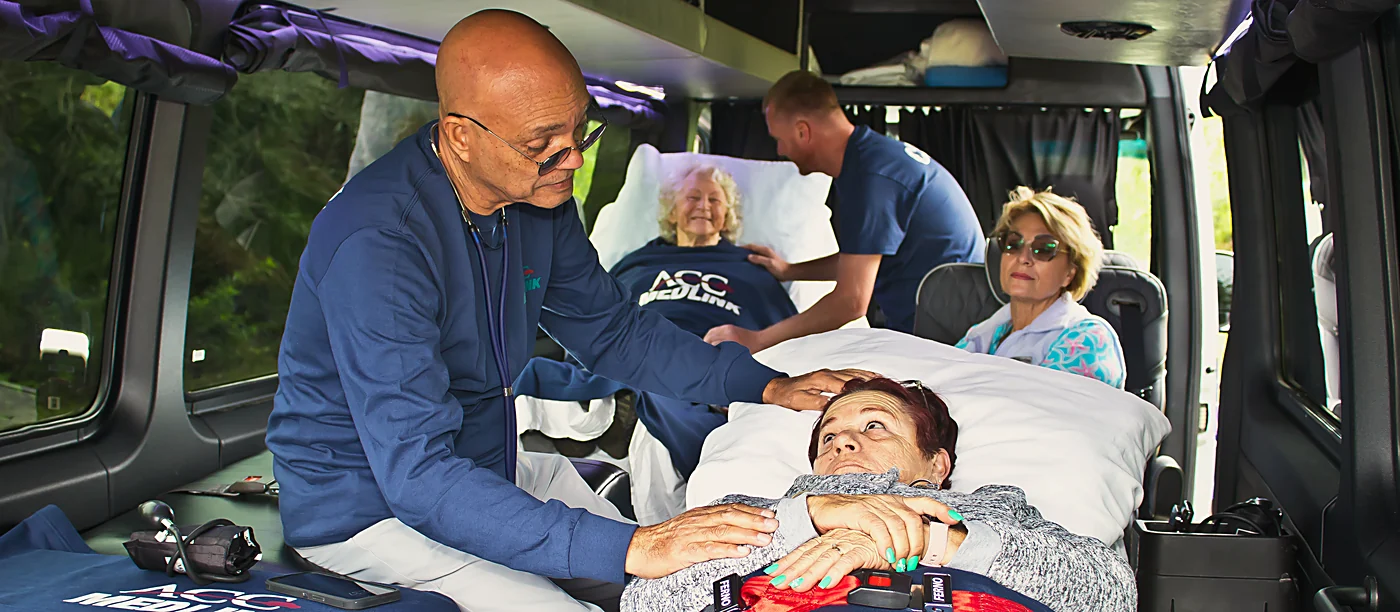
Long distance non-emergency medical transport moves a medically stable patient hundreds of miles (often state to state) in a medical vehicle with a real bed and a trained medical attendant aboard. “Non-emergency” means scheduled and calm: no sirens, no scramble, just planned medical care in motion.
“Non-emergency” is the most misunderstood word in medical transport. It does not mean unimportant. It means no one's life is in danger in the next hour, so the trip can be planned instead of rushed. A set pickup time, a mapped route, medications on schedule, and a bed instead of a bench seat.
It's built for the patient who falls between every other option: too fragile to sit up in a car all day, not cleared for a commercial flight, and nowhere near sick enough to need an air ambulance. That gap is exactly what we do. And it's the service families ask us for more than any other.
You'll also see it shortened to NEMT. That label covers a wide range of rides, from a wheelchair van to a dialysis appointment across town to a 1,200-mile move from Florida to Michigan. Most NEMT companies do the short, local kind. We do only the long kind: 200 miles and up, in the lower 48 states.
Local NEMT vs. long distance non-emergency transport
Search “non-emergency medical transportation” and you'll find both kinds mixed together. They solve different problems, so it's worth knowing which one you need before you start calling.
Rides around town
- Trips: dialysis, doctor visits, therapy sessions, a short hop home from the hospital
- Distance: usually inside one city or county
- Vehicle: a wheelchair van, ambulette, or sedan
- On board: a driver, sometimes an assistant; rarely a medical professional
- Booking: through a local provider, often set up by a clinic or care facility
Curious what an ambulette is? Read what an ambulette is and how it differs from an ambulance.
Trips across states
- Trips: hospital to home, rehab to a new facility, a parent moving closer to family
- Distance: 200 miles and up, state to state or coast to coast
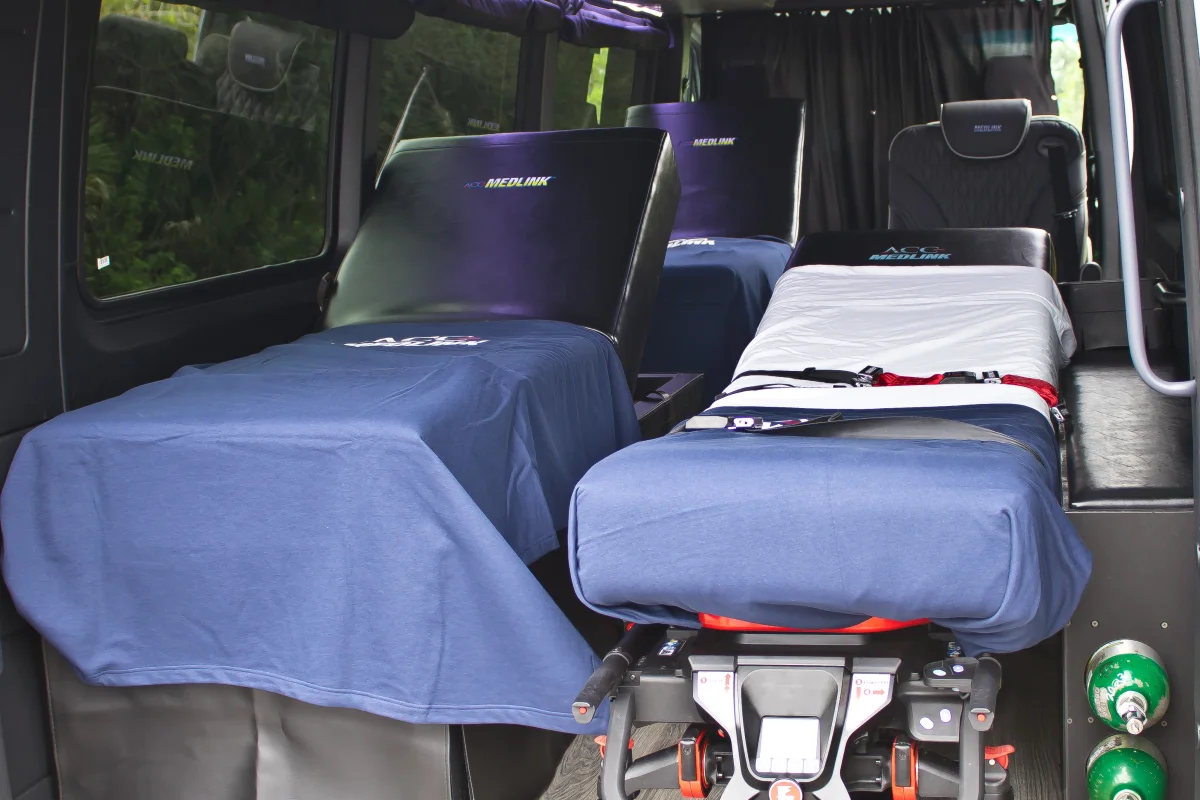
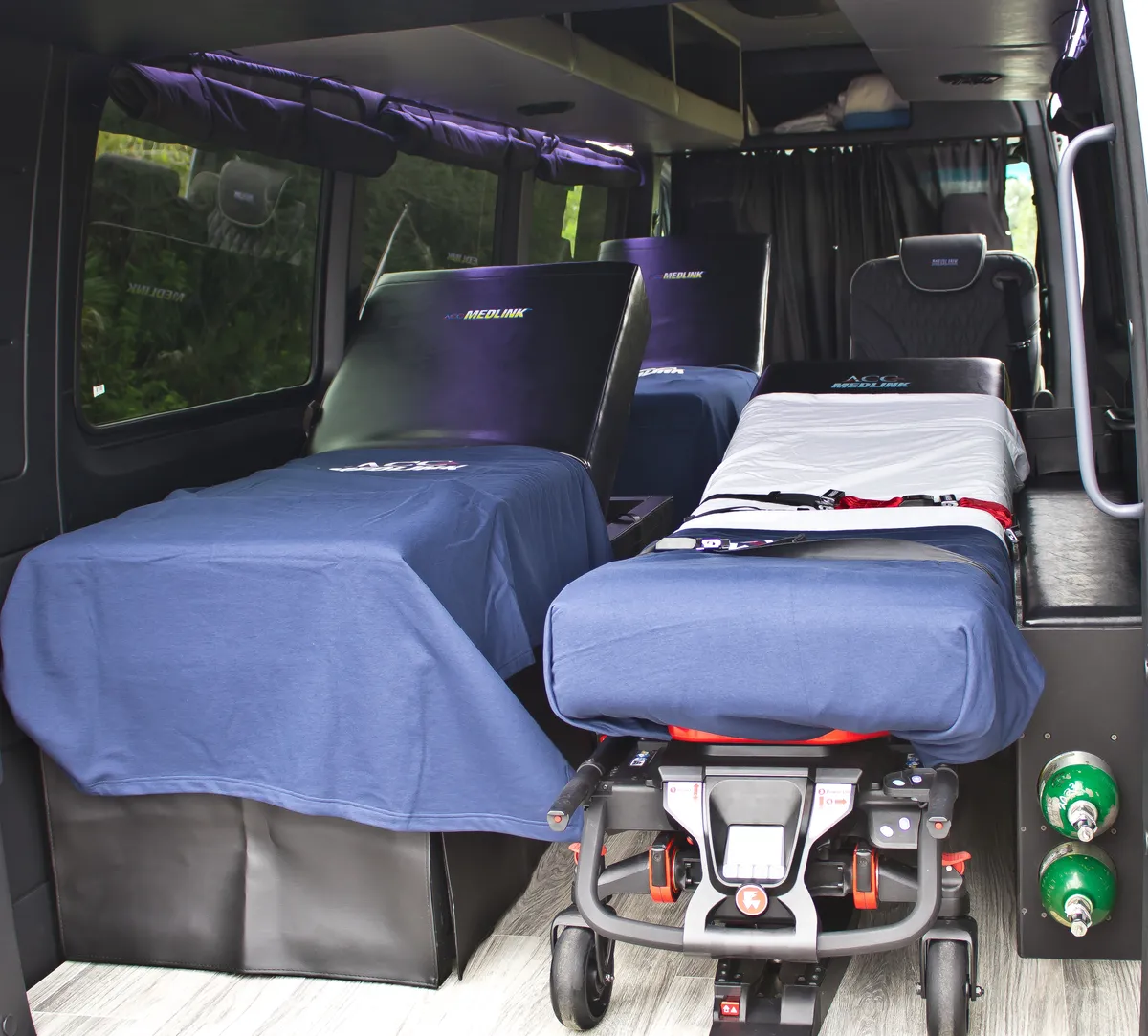
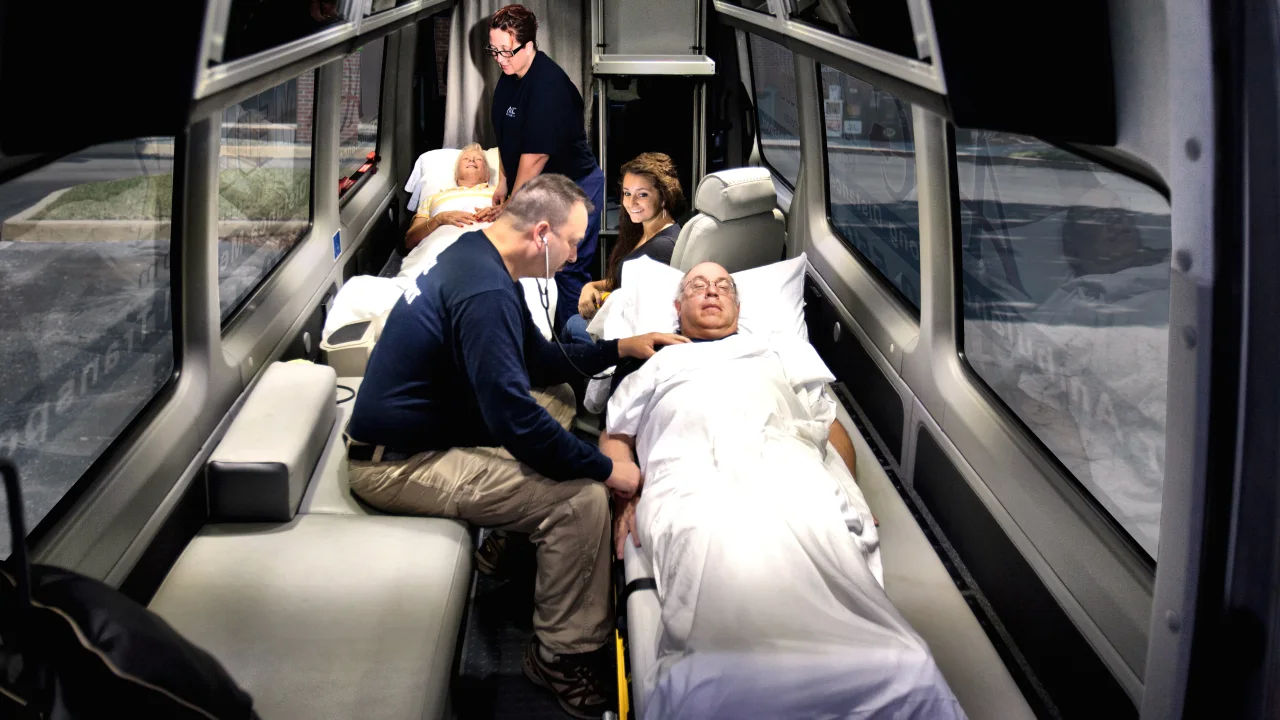
- Vehicle: a Mercedes Sprinter with a real bed on a memory-foam mattress
- On board: a licensed medical professional at the bedside, two rotating drivers on long routes, and room for family
- Booking: one call to us, one written quote the same day, private-pay
Moving between states? See state-to-state medical transport or coast-to-coast trips.
Need a ride under 200 miles? We're not the right company for that trip, and we'd rather tell you now than waste your afternoon. A local NEMT or ambulette provider near the patient will serve you better and cost far less. Our minimum is 200 miles because every trip carries a full medical crew and a vehicle built for a long day on the road. Going farther in a wheelchair? See our long-distance ambulette service.
Families who made this exact trip
2,500+ five-star reviews from families we've transported. A few from trips like yours.
families we've transported
“I would like to thank the team who brought my sister home. Suzan was very kind and kept us updated the entire trip. The driver's Shava and Jenny were on time in both directions. Everyone was great! Thank you ACC for assisting our family with a major transition.”
“DeAngelo, James, and Eric were highly professional and extremely patient with our father who has dementia. They even helped him to relax by playing his favorite music. They let me know every detail of the trip prior to picking him up, when picking him up, and during the transportation time, and had…”
“Asking someone to transport your aged father with dementia halfway across the country is very much an act of trust. ACC Medlink, and their employees Bernard, Francis, and Erik exceeded our expectations. Their communications with us and the two care facilities involved was outstanding. They were…”
“Great team, took very great care of our family member. Thanks Davonta Keith and Tyron safe travels guys!”
“We had a great team with Linda, Bernard & Eric. They were very caring & respectful of our mother & our family members. They made every effort to keep our mom comfortable for our 25 hour trip.”
“5+!!! The process from beginning to end went well. Communication was thorough. The crew took good care of my sister and my aunt who traveled with her.”
Picture the trip with the sirens turned off
- Pickup
The van arrives when we said it would. No flashing lights, no rush. The crew walks in, introduces themselves to your mother by name, and moves her onto the bed themselves. You don't lift anything.
- On the road
Then the trip just… happens. She dozes on the memory-foam mattress while the entertainment system plays her show. The medical attendant checks on her, keeps every medication on its schedule, adjusts a pillow before she asks. You're in a seat right beside her, with a bed to rest on, watching the country roll by instead of white-knuckling a rental car.
- Overnight
Two drivers rotate so the vehicle keeps moving safely while she sleeps.
- Arrival
At the far end, the crew carries her bag in, settles her into her own bed, and hands off exactly as planned, because the whole thing was planned. That's what non-emergency really means.
Who long distance non-emergency transport is for
If a doctor would call your loved one medically stable (not in crisis, but not able to travel on their own) this is their ride. The families we hear from most:
Post-surgery patients
Discharged far from home after a hip, knee, spine, or heart procedure: healing, but in no shape for a long car ride or an airport. A real bed lets them rest flat the whole way.
Elderly parents relocating
Moving closer to the kids and grandkids, or into assisted living near family. Senior transport is our normal week.
Facility-to-facility transfers
Hospital to rehab, assisted living to memory care, state to state. We coordinate with the staff at both ends so the hand-off is clean.
Hospice patients going home
When the goal is to be home, or near family, for the time that's left. Gentle, unhurried, with family beside the bed. See hospice transport.
Dementia and travel anxiety
An airport is overwhelming for someone with Alzheimer's. One calm vehicle, one crew, and a familiar face right beside them is not.
Bedbound and stretcher-only
Patients who can't sit up for hours travel lying down, moved bed to bed by the crew. Larger patients ride with bariatric equipment arranged in advance.
Oxygen, wheelchair, stretcher-only, dementia, anxiety about travel: all routine for our crews, in some of the most spacious vans in the industry.
What's on board for a long non-emergency trip
A local NEMT van is built to get someone across town. Ours is built for a long day, and sometimes a night, on the road. Here's what travels with your loved one:
- A real bedA memory-foam mattress on a power stretcher, so they can lie flat, sleep, and be turned comfortably.
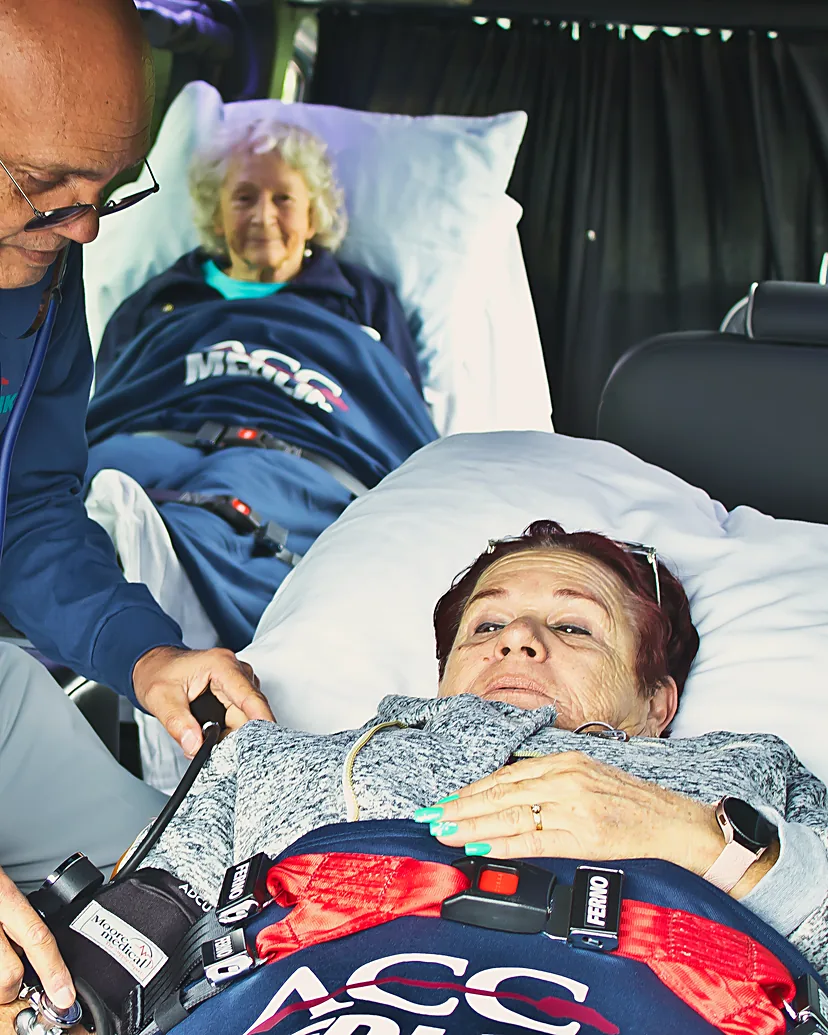
- A licensed medical professionalBeside the bed for the entire trip, checking vitals and comfort without being asked.
- Oxygen and monitoringOxygen aboard and set to the prescribed flow, plus monitoring equipment checked before pickup.
- Medications on scheduleWe follow the medication list you or the facility give us, dose by dose, mile by mile.
- A seat and a bed for familyRight beside the patient. Most families send one or two people along.
- Comfort for a long dayClimate control, entertainment, and room to stand and care for the patient properly.
Every vehicle is a fully licensed Mercedes Sprinter that we own and maintain. See the fleet up close.
How booking a non-emergency medical trip works
-
1
Call us once
Tell us the two addresses and the travel date. You'll have a same-day quote. The quote you approve is the price you pay.
-
2
We plan everything
Our coordinator handles records, medication schedules, oxygen, and timing, working directly with the hospital or facility when there is one.
-
3
Travel day, bed to bed
Our own crew and vehicle, door through door. They handle every lift and settle your loved one in at the other end.
What we'll ask you on the first call
Have these handy and the quote takes minutes. Don't have them all? Call anyway. We'll fill in the rest with the hospital or facility.
- Pickup and drop-off addresses, and the facility names if there are any
- The date you're aiming for, or the expected discharge date
- Your loved one's condition and mobility: can they sit up, stand, or transfer?
- Oxygen use and flow rate, and any equipment that has to come along
- Height and weight, so the right stretcher and crew are assigned
- Who's riding along, and a contact at each facility
“The crew was fantastic. This was our first time using a medical transport company so I wasn't sure what to expect.”
The crew that answers the phone is the crew that drives
Plenty of “transport companies” are really dispatch desks: they take your booking, then farm the actual trip out to whoever bids cheapest. You find out who's really carrying your father when the van pulls up. When you're arranging the trip yourself, book private medical transport directly with the company that does the work.
We own every Mercedes Sprinter in our fleet and build every crew ourselves: the coordinator, the two rotating drivers, and the medical professional beside the bed. One company, one standard, the whole route. Fully licensed, with over ten million patient miles since 2010.
- 200-mile minimumAnywhere in the 48 lower states.
- Family rides alongWith a real seat and a bed to rest on, right beside the patient.
- Memory-foam mattress, entertainment systemsAmong the most spacious vans on the road.
Compare ACC Medlink to the competition
How our Sprinters stack up against the vehicles other services send.
| ACC MedlinkMercedes Sprinter | Competitor Minivan Services |
Competitor RV Services |
|---|---|---|
| Two professional drivers & a medical professionalMedical attendants can stand and properly care for the patient en route | Two drivers onlyTight space, no headroom No room for proper care |
Medic and two driversNo way to load a stretcher onto an RV No room for proper care |
| Our own Mercedes Sprinter fleetNationwide fleet, expertly maintained Fully licensed |
Questionable safety recordQuestionable maintenance record | Structure not built for passengersQuestionable maintenance record No crash-safety standards required |
| Real beds with memory-foam mattressesA real bed, not a reclined seat | Thin plastic mattress | Hospital-type bed |
| Custom bedside commodeDignified access, no transfers | Bedpan only | Small ambulatory bathroomNot ideal for patient transfer |
| Low-emission vehiclesBlueTEC SCR technology Complies with strict EPA/CARB standards |
Not low-emission | Not low-emission |
Non-emergency transport questions
Don't see yours? Call. A real person on our team answers, day or night.
How much does long distance non-emergency medical transport cost?
Does “non-emergency” mean my parent's trip isn't a priority?
Who qualifies for non-emergency medical transport?
Can I ride along with my loved one?
How soon can a non-emergency trip be scheduled?
Do you do short or local non-emergency rides?
What's the difference between non-emergency medical transport and an ambulance?
Can the patient lie down for the whole trip?
What do we need to have ready on travel day?
Reviewed by the ACC Medlink teamUpdated How we review our pages
Planned. Calm. Bed to bed.
Tell us where your loved one is and where they need to be. You'll have a real number today, and we handle everything between.
2,500+ reviews10M+ patient milesSince 2010