You’re the one everyone calls. The hospital wants a discharge date, your siblings want updates, and your mom or dad needs to get to a new home, a new facility, or your guest room in another state. Nobody gave you a manual for this, and you’re doing it on top of a job and a life.
Consider this the manual, written the way our coordinators talk families through it on the phone. This caregiver’s guide to long-distance medical transport is a checklist in four stages: make sure the trip is safe and the other end is ready, book it and gather the papers, get through pickup day, and settle in at the new place. Work through it in order. If the hospital already said “Thursday,” do the three things directly below, then call us.
Short on Time? Do These Three First
- Ask the doctor one question: “Is she stable enough to ride lying down for about this many hours?” Get the answer in writing if you can.
- Call the place she’s going. Confirm they’ll take her on that date, and ask what hours they accept new arrivals.
- Call for a quote with the two addresses and a rough date. You’ll have the price the same day, and nothing is booked until you say so.
Everything else can wait until those three are done, and the hospital and our coordinator sort out much of it between them.
Caregiver Guide to Long-Distance Medical Transport: Is a Medical Van the Right Fit?
A medical van is for someone who is medically stable but can’t safely make the trip by car or plane. A few quick rules:
- If she can sit up for hours, walk through an airport, and her doctor clears her to fly, a regular flight with family, or with a commercial medical escort, may be simpler.
- If she has to lie down, needs help with every transfer, uses oxygen, or gets confused in crowds, a bed-to-bed medical van is usually the better fit.
- If she needs ICU-level care on the way, or minutes truly matter, ask the doctor about an air ambulance.
- If the trip is under 200 miles, look for a local provider. Our trips start at 200 miles.
Our complete guide to long-distance medical transport goes deeper on each option.
How to Arrange Long-Distance Medical Transport: Two to Four Weeks Out
If you have a few weeks, this is where the trip gets easy. If you don’t, that’s normal. Plenty of trips come together in days.
Medical
- Ask the doctor what could change their answer about travel, and what medications and supplies she’ll need for the road.
- If she has a DNR or POLST form, ask whether it will be honored in the destination state or whether she’ll need a new one there.
- Line up a doctor at the destination, or confirm the receiving facility has one. For hospice, the receiving hospice program should be in place before she travels.
- If she has dementia or gets anxious, ask the doctor now whether anything should change in her medications for a long ride. That’s the doctor’s call, and it’s far easier to settle this week than at 6 a.m. on pickup day.
The other end
- Confirm the arrival date with the receiving facility, and ask about their admission paperwork.
- If she’s moving into a home, order what she’ll need there (hospital bed, oxygen, commode, walker) to arrive before she does.
- Walk the path from the curb to her bed. Stairs, narrow halls, and tight corners are worth mentioning on the first call.
Family and money
- Decide who will ride along. Up to two family members can usually come.
- Find the power of attorney or healthcare proxy papers and make copies.
- Decide who is paying, and how. It’s private-pay: card, check, Zelle, or wire. Ask about CareCredit financing, and mention it if she’s a veteran.
- If you’re riding along, plan your own way home. After drop-off, the van heads on to its next trip.
The Worries Caregivers Don’t Say Out Loud
The checklist is the easy part. These are the questions people tend to ask us quietly, near the end of the call.
What if my siblings don’t agree?
Often they don’t, and it’s rarely about the van. One thinks Mom should stay put. Another has already toured a place near them. Settle the decision before you book, ideally with her doctor or the hospital social worker in the room. Then name two people: the one who makes decisions (usually whoever holds the healthcare power of attorney) and the one who talks to us. If two of you share that power of attorney, both should hear the plan. A family argument in the hallway on pickup morning is hardest of all on the patient.
What if the hospital moves the discharge up?
It happens all the time. “Next week” becomes “tomorrow” after morning rounds. Tell the case manager early that we usually need 24 to 48 hours’ notice, or about 72 from the far West, and ask for a heads-up the moment a date firms up. A date isn’t held until the trip is booked, and openings change day to day, so call as soon as the date is real. If it moves again, call again. The coordinator works backward from whatever date the hospital gives.
What if Mom doesn’t want to go?
Families feel guilty even asking this one. Some parents agree on the phone and balk at the door. Our crews can’t put anyone on the van against their will, so a firm “no” at pickup usually means the trip is canceled. What helps: talk it through with her well before travel day, with the doctor if she trusts the doctor. Agree as a family on how you’ll describe where she’s going, and tell the coordinator, so the crew uses the same words you do. And have a familiar face there at pickup. If you can ride along, do.
Will this wipe out her savings?
It’s a real expense, and we won’t pretend otherwise. The price mostly comes down to distance and the level of care she needs. You’ll get an itemized quote the same day, and the quote you approve is the price you pay. CareCredit can spread the cost out. If you want to know what moves the number before you call, read what drives the price.
Questions to Ask Any Transport Company
Write the answers down. A company worth hiring will answer every one plainly.
- Do you own your vehicles and employ your crews, or do you hand the trip to someone else?
- Who will be in the back with my mother, and what are their qualifications?
- Will she lie in a real bed, or on a bare stretcher or a reclined seat?
- How many family members can ride along?
- What medical equipment is on board? Is there oxygen?
- How many drivers? Do you drive straight through or stop at motels?
- What happens if there’s a medical emergency on the way?
- Is the quote itemized, and is it the final price?
- What’s your cancellation policy? Can I have it in writing?
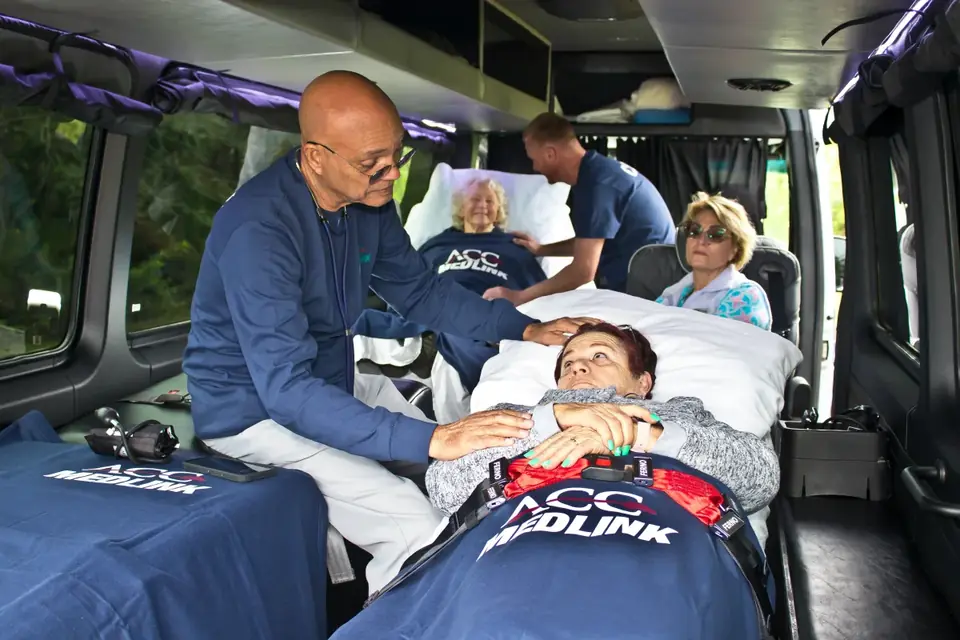
Our own answers, for comparison: we own our Mercedes Sprinter vans and employ our crews, so the people you booked are the people who show up. A licensed medical professional sits beside the bed the whole way, oxygen is on board, and two drivers trade off on long runs. If an emergency comes up, the crew heads straight to the nearest emergency room.
The Long-Distance Medical Transport Checklist: Two to Seven Days Out
Paperwork
- Photo ID
- A current medication list with doses and times
- Discharge papers or a recent medical summary (if she’s in a facility, our coordinator usually gets these from the staff directly)
- Power of attorney or healthcare proxy, plus any advance directive or DNR
- Phone numbers for the sending facility, the receiving facility or home, and your one family point person
Medications
- Refill prescriptions so there’s enough for the trip plus a couple of extra days.
- Pack trip medications in their original containers, in a bag the crew can reach.
- Move her prescriptions to a pharmacy near the new home now, so the first refill isn’t a scramble.
Packing
Plan on four to six carry-on-size bags for everyone together. Up front, where she can reach them:
- Loose, comfortable clothes, a warm layer, and a full change of clothes
- Glasses, hearing aids, and dentures, in labeled cases
- Her own pillow or blanket
- Phone, charger, headphones, and the music or shows she likes
- Any special-diet snacks (drinks and snacks are on board, plus a cooler)
The Things Almost Everyone Forgets
These are the items that get left behind most often:
- Spare hearing aid batteries
- The phone charger still plugged in beside the hospital bed
- The photo on the nightstand, and the rings in the bedside drawer
- Your own medications, toothbrush, and a change of clothes, if you’re riding along
- A note for the new staff: how she takes her coffee, what she likes to be called, what calms her
- Telling the receiving end about the dog, the stairs, or the gate code
Pickup Day
- Put the medications, the medication list, and the paperwork in one bag by the door.
- Dress her comfortably. Skip tight waistbands and fiddly buttons.
- Keep the morning calm. If she has a best time of day, ask whether pickup can match it.
- Let the crew do every lift. Your job is to answer questions and hold her hand.
- If you’re riding along, eat something before you leave.
On the road, meal stops happen when she wants them, and there’s a bedside commode with a privacy curtain on board. If you’re not riding along, agree ahead of time on who gets updates and how often.
Arrival and the First Week
- The crew brings her inside, settles her into bed, and briefs the receiving staff or family.
- Check that every medication, document, and bag made it inside before the van leaves.
- Confirm her first appointment with the new doctor, or the first home health or hospice visit.
- Fill the first prescriptions at the new pharmacy.
- Forward her mail and update her address with anyone who sends checks or benefits.
- Expect a few unsettled days. New rooms take time, especially with dementia. Familiar things and a familiar face help most.
And Then There’s You
November is National Family Caregivers Month. Nobody hands out awards for it, so take the practical version instead. Give a sibling the jobs that can be done from far away, like calling pharmacies or forwarding mail. Keep every number and document in one folder, paper or phone, so you’re never hunting for something at the worst moment. And sleep the night before pickup if you possibly can. The day goes better when the person running it has had some rest.
You don’t need every box ticked before you call. Most people call with half of them blank. Tell us the two addresses, roughly when, and how your mom is doing, and you’ll have a price the same day, with no obligation. Or read more about ACC Medlink’s long-distance medical transport first.
Call 800-550-1025 any hour of the day, or request a same-day quote online.